
Why are you getting traffic but no Sales?
Traffic without sales is one of the most demoralising experiences in ecommerce. You've invested in SEO, paid ads, social media, maybe even influencer partnerships - and people are coming. The analytics dashboard says so. Yet the sales notifications stay silent.
Here's the uncomfortable truth: traffic and sales are two entirely different problems. Getting people to your store is a marketing challenge. Convincing them to buy is a conversion challenge. And most store owners are only solving the first one.
The average ecommerce conversion rate sits between 1 - 3%. That means even a "healthy" store turns away 97 out of every 100 visitors. The difference between a struggling store and a thriving one often comes down to systematic diagnosis finding and fixing the specific friction points that are quietly killing your sales.
Understanding Your Funnel First
Before diagnosing what's wrong, you need to understand where visitors are dropping off. The ecommerce funnel has distinct stages and the leak could be at any one of them. Traffic brings 100% of visitors to your site. Of those, roughly 60% will engage and browse product pages. Around 30% will show intent by adding something to their cart. About 15% will begin the checkout process. And only around 2.5% will complete a purchase.
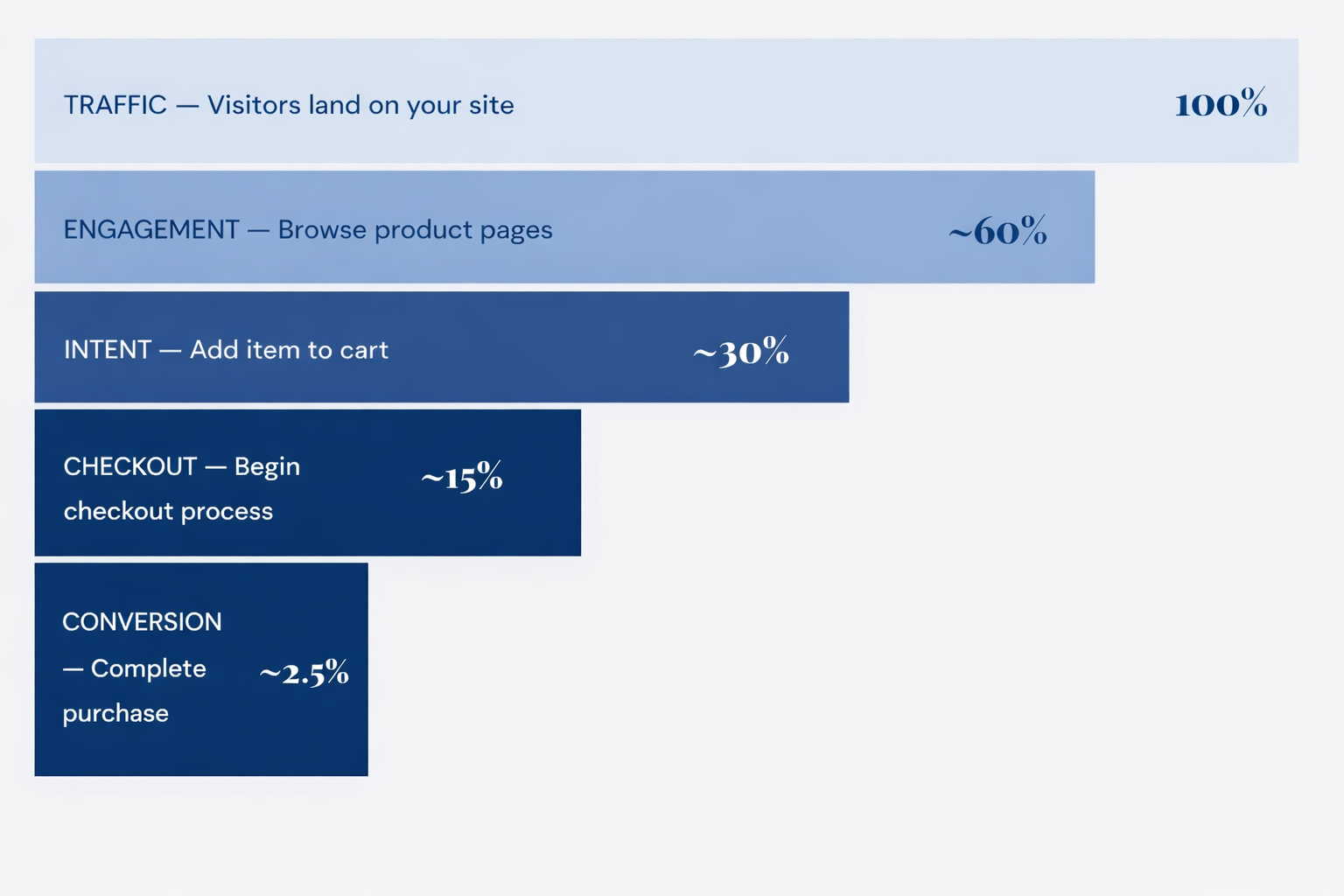
Check your own analytics against this model. If you have strong engagement but low add-to-cart rates, your product pages are the problem. High cart rates but low checkout completions? The issue is in checkout friction or trust.
1. Wrong Traffic: You're Attracting the Wrong People
This is the most overlooked cause of low conversions. Not all traffic is equal. Ranking for broad, high-volume keywords — or running ads with wide audience targeting — floods your store with people who were never likely to buy.
A store selling premium handmade leather wallets at £140 does not want to rank for "cheap wallets." The traffic will come. The sales won't. The mismatch between who's arriving and what you're selling creates a fundamental conversion problem that no amount of website optimisation will fix.
To diagnose it, look at your bounce rate by traffic source in Google Analytics. High bounce rates on specific channels — particularly paid social or broad organic terms — signal intent misalignment. Check which keywords are driving traffic versus which drive revenue. These are often very different lists.
To fix it, audit your top 20 organic keywords and ask whether they are purchase-intent terms or merely informational. Review paid ad audiences and eliminate broad match targeting that burns budget on unqualified clicks. Check referral traffic sources to see whether they are sending engaged users or bouncing visitors. Build out long-tail, high-intent keyword content — "best X for Y" consistently outperforms "what is X." Use negative keywords aggressively in PPC campaigns to filter out irrelevant searches.
2. Weak Product Pages That Don't Convert
Your product page is your salesperson. If it doesn't communicate value, build desire, and overcome objections within a few seconds of landing, visitors leave. Most ecommerce product pages are shockingly underdeveloped — a few stock photos, a brief description, and a price.
The best product pages do several jobs simultaneously: they educate, they build emotional connection, they address doubts, and they create urgency. They answer the unspoken questions every shopper has: Does this actually work? Will it fit? Is it worth the price? Can I trust this brand?
Your product page isn't a listing. It's a conversation — and you need to win it before the customer clicks away.
Strong product pages include high-quality images from multiple angles, including lifestyle shots showing the product in use. They feature video demonstrations where the product has features better shown than described. The copy is benefit-led rather than a list of features — it tells people what the product does for them. Decision-making aids like size guides and compatibility charts are present where relevant. Reviews are displayed prominently, ideally with photos and specific use-case details. The call-to-action is clear and prominent with minimal surrounding distraction. A FAQ section pre-empts common hesitations before they become objections.
3. Trust Signals Are Missing or Weak
Online shopping requires an act of faith. A customer hands over their card details, their personal information, and their money — and receives nothing tangible in return until days later. If your store doesn't actively build trust, the rational response is to leave and buy from Amazon or a recognisable brand instead.
Trust is built through accumulated signals, many of which are invisible when present but glaring when absent. An SSL certificate, a professional design, real customer reviews, a human contact address, a clear returns policy — none of these feel like conversion levers, but together they form the credibility foundation every purchase decision rests on.
Common trust gaps that kill conversions include having no "About Us" page or a thin, generic one. No visible phone number or physical address. A returns policy buried in the footer or written in defensive legalese. Reviews that look fake — all five stars, no detail, no dates. An SSL certificate that has expired or is missing on certain pages. No social proof beyond the product page itself — no press mentions, no partnerships, no community.
For newer stores with limited reviews, trust-building requires extra creativity. Show your manufacturing process, introduce the founders, display your social media following, get press coverage, and offer a money-back guarantee prominently. Every element that says "real people stand behind this" reduces purchase hesitation.
4. Pricing and Value Proposition Problems
Price is almost never the real reason people don't buy — but value is. There is a critical difference. Customers will pay a premium for products when they understand what justifies it. They won't buy even cheap products when the value case isn't made clearly.
If your traffic is coming from price-comparison keywords, comparison shopping engines, or discount-oriented social audiences, you're attracting the most price-sensitive shoppers to potentially your most premium products. That's a structural mismatch.
Equally important is how price is presented. A price shown in isolation forces the customer to mentally calculate whether it's worth it. A price shown alongside a comparison — "equivalent products cost £200, ours is £89" — a cost-per-use framing, or a clear quality story entirely changes the perception.
To address this, make your unique selling proposition visible above the fold on every product page. Use anchor pricing to show the original or comparative price and contextualise your offer. Reframe price as cost-per-use, cost-per-day, or lifetime value where relevant. Test bundle pricing to increase average order value and perceived deal quality. Ensure your brand story explains why you're priced the way you are — don't leave it to the customer to guess.
5. Checkout Friction Is Driving Abandonment
A customer who adds something to their cart has already made the most important decision — they want it. Checkout abandonment is not a desire problem; it's an execution problem. Something between "add to cart" and "order confirmed" is causing them to stop.
The main culprits are well-documented: mandatory account creation, unexpected shipping costs appearing late in the process, a confusing multi-step checkout, limited payment options, and a checkout that doesn't feel secure. Each of these issues is entirely fixable, and fixing them tends to produce some of the highest-return conversion improvements available.
The single biggest checkout mistake is mandatory account creation before purchase. This single friction point causes a significant percentage of checkout abandonments. Always offer a guest checkout option. You can invite account creation after the purchase is confirmed.
Beyond that, show all costs — shipping, taxes, fees — as early as possible, ideally on the product page itself. Offer a breadth of payment methods including card, PayPal, Apple Pay, and Buy Now Pay Later options. Reduce form fields to the absolute minimum required. Display security badges, SSL indicators, and accepted payment logos prominently. Add a progress indicator for multi-step checkouts so customers know how close they are to completion. Set up abandoned cart email sequences — a well-timed follow-up series can recover 10–15% of abandonments.
6. Mobile Experience Is Broken
More than half of ecommerce traffic now comes from mobile devices. Yet mobile conversion rates consistently lag behind desktop by a factor of two or three. If your store isn't genuinely optimised for mobile — not just responsive in the technical sense, but actually pleasant and frictionless to use on a small touchscreen — you're haemorrhaging conversions.
Common mobile failures include text that requires zooming, buttons too small to tap accurately, images that load slowly on mobile networks, checkout forms that are awkward to fill on a keyboard, and pop-ups that obscure content and can't be easily dismissed. These issues rarely show up in desktop testing, which is why many store owners don't realise they exist.
The fix is to test your store on actual mobile devices, not just browser emulators. Use Google's PageSpeed Insights to identify mobile performance issues. Run heatmap tools like Hotjar on mobile sessions to see exactly where users are struggling and where they drop off.
7. Speed and Technical Performance
Page speed is both a conversion issue and an SEO issue. A one-second delay in page load time reduces conversions measurably. At three seconds, over half of mobile visitors have already left. This is not a nice-to-have — it's a direct revenue lever.
Heavy, unoptimised product images are usually the biggest offender. An ecommerce site with dozens of high-resolution, uncompressed images can load in eight or ten seconds — an eternity in the attention economy. Combine this with slow hosting, heavy apps and plugins, and large unminified scripts, and you have a store that is technically working but commercially broken.
The quick wins are straightforward:
Compress and convert all product images to WebP format, aiming for under 100kb per image.
Implement lazy loading so below-the-fold images only load when scrolled to.
Audit your apps and plugins and remove anything not directly contributing to sales.
Use a CDN to serve assets from servers closer to your customers.
Run Google PageSpeed Insights and Core Web Vitals regularly, aiming for a score above 70 on mobile.
8. You're Not Retargeting or Nurturing
Most first-time visitors to any ecommerce store are not ready to buy. They're researching, comparing, price-checking, or simply browsing. The question is not whether to convert them on the first visit — that's often unrealistic. The question is whether you have a system to bring them back when they are ready.
Without retargeting ads and email capture, every visitor who leaves without buying is simply gone. With them, they become part of a nurturing funnel that keeps your brand present until the moment they're ready to purchase.
It takes an average of 6–8 marketing touchpoints to convert a cold lead into a sale. Most stores give up after one.
To build a retargeting and nurture system, install Meta Pixel and Google Tag Manager to enable retargeting across platforms. Create segmented retargeting audiences for product viewers, cart abandoners, and past purchasers — these groups need different messages. Add an email capture mechanism with a compelling incentive such as a discount, guide, or early access offer. Build a welcome email sequence that delivers value before making the sale. Use post-purchase email flows to encourage repeat buying and referrals. Create dynamic retargeting ads that show the exact products a visitor previously viewed.
The Diagnostic Mindset
Traffic without sales is not a failure — it's a signal. Every gap between visit and purchase is data telling you exactly where your store's friction lies. The stores that succeed at conversion are not the ones with the best products or the biggest ad budgets. They're the ones that treat their store as a system to be continually diagnosed and improved.
Start with your analytics. Find where in the funnel you're losing people. Pick one problem to fix first — the one that affects the most visitors — and test a solution systematically. Measure. Iterate. Then move to the next friction point.
Conversion rate optimisation is not a one-time project. It's a discipline. And the compounding effect of fixing five 20% problems is transformative: you don't need more traffic. You need to do more with what you already have.
